







This Financial Literacy Month requires a candid assessment of why the American financial education system is failing the very people it aims to protect. While traditional narratives focus on individual budgeting habits, the data suggests a more profound issue: a systemic lack of the foundational knowledge required to navigate a modern economy.

During a recent Bloomberg segment, Esusu co-founders Wemimo Abbey and Samir Goel addressed this disconnect. For Gen Z, the gap between financial ambition and the reality of the housing market has reached a breaking point. This generation is currently more rent-burdened and further from homeownership than any predecessor, largely because the tools for advancement remain obscured.
The Big Three Diagnostic
In 2004, economists Annamaria Lusardi and Olivia Mitchell identified a specific cause for the financial ruin facing many otherwise stable Americans. They developed a diagnostic tool known as the Big Three—three questions designed to measure an individual’s grasp of interest rates, inflation, and risk diversification.
The results of the 2021 National Financial Capability Study indicate that these fundamental concepts remain elusive. Less than 30 percent of Americans could answer all three correctly. For adults under 35, that proficiency dropped to 14 percent. By 2025, the TIAA Institute-GFLEC Personal Finance Index confirmed that this trend is stagnant. The average American adult consistently fails to correctly answer more than half of basic financial health questions. In a professional or academic environment, a 50 percent score represents a failure; in a credit-driven economy, it represents a path to generational poverty.
The Rent Worth Gap Report: Gen Z in the Crosshairs
To analyze how this lack of information impacts the housing market, we examined a subset of 2,000 renters (ages 18-80) through the Rent Worth Gap Report. The findings provide an empirical look at the barriers facing the youngest segment of the workforce.
- Mortgage Inversion: 30 percent of Gen Z renters report paying monthly housing costs that exceed the cost of a mortgage in their specific area.
- The Awareness Deficit: 54 percent of Gen Z renters are unaware that rent reporting services exist.
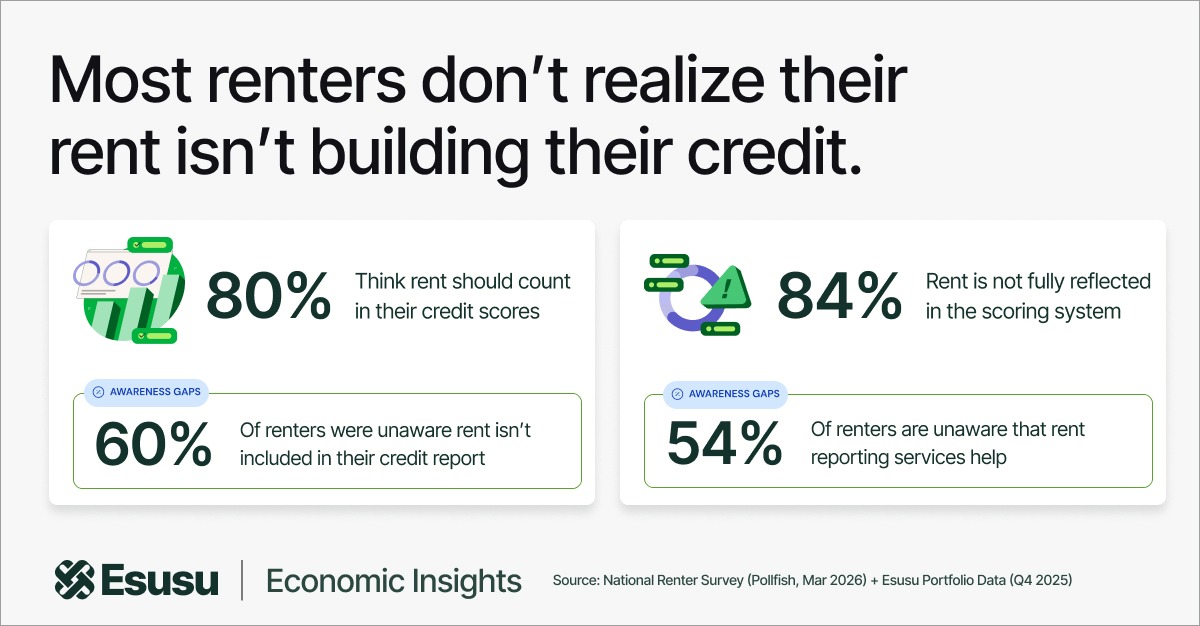
This means a majority of young renters are fulfilling the financial obligations of a homeowner without receiving the credit-building benefits that come with a mortgage. They are participating in the economy but are being denied the data-driven rewards of their participation.
For renters feeling that pressure in real time, our guide on how to negotiate rent on a new lease or renewal breaks down how to ask for lower rent, compare nearby listings, and negotiate concessions before signing.
A Structural Failure of Risk Comprehension
Financial illiteracy is rarely an individual shortcoming. It is a structural byproduct of an education system that has not kept pace with the complexity of modern fintech. The lowest literacy scores are concentrated among women, Black and Hispanic Americans, and Gen Z.
The most significant area of failure involves the comprehension of risk. In the 2025 P-Fin Report, only 36 percent of risk-related questions were answered correctly by participants. When consumers cannot accurately assess risk, they are left vulnerable to predatory lending and high-interest debt cycles. We are currently observing a population forced to navigate a high-stakes financial landscape without a functional compass.
Moving Beyond Literacy to Measurable Outcomes
Data from the Rent Worth Gap Report proves that access to information changes behavior and financial trajectory. By incorporating rental data into the credit system for millions of working Americans, we are shifting the focus from theoretical literacy to tangible wealth creation.
April Financial Literacy Month should be a call to standardize the tools of transparency. Knowledge of the system is irrelevant if the system refuses to acknowledge the consumer’s largest monthly expense. Bridging the gap for Gen Z requires more than just better classrooms; it requires the immediate integration of rental history into the core of American credit reporting.
Are you ready to start building your financial legacy?
Don't let your biggest monthly expense go unrewarded. This month, become an Esusu Member to start reporting your rent, tracking your score and getting the coaching you need to turn the key to your own front door.


.png)

