







When we started Esusu nearly a decade ago, the credit world felt a bit like an exclusive club with a “members only” sign on the door. To get in, you needed a car loan, a stack of credit cards, or student debt.
But there was a glaring $2,000+ hole in that logic: Your rent.
For years, the biggest check you wrote every month was invisible to the people who decide if you’re good for the money. Rent is often a household’s largest monthly expense, yet it has traditionally not been included in credit reports, limiting access to the mainstream financial system for millions of renters.
In 2026, your rent is no longer just a cost of living; it’s your financial resume.
The 2026 Shift: From "Alternative" to Essential
If you’ve felt like the goalposts for homeownership keep moving, you aren’t alone. But here’s the good news: the “powers that be” are finally catching up to you.
According to a 2025 TransUnion report, 13% of all renters now report their payment history to the credit bureaus—a steady climb that shows this is no longer a fringe benefit. Even better? Modern scoring models like VantageScore 4.0 and FICO 10 now treat rent as a tradeline equivalent to a mortgage payment. In addition, the Federal Housing Finance Agency (FHFA) has recently mandated that Fannie Mae and Freddie Mac accept VantageScore 4.0.
What does that mean in plain English? It means when you apply for a mortgage, the bank is now required to look at your history of on-time rent payments. Tenants can actively opt in to have their rent payments reported from their current lease to the credit bureaus by choosing to participate through their landlord, property manager, or by downloading an app.
For the Maryland landlord side of that process, our guide Maryland HB 315 Rent Reporting: What Covered Landlords Need to Know explains when covered landlords must present the option, what the written offer must include, and how optional reporting fees are treated under HB 315.
If you want to better understand what that process actually involves, our guide explains what rent reporting is, how enrollment works, and what questions to ask before choosing a service.
You can expect to see a rental tradeline appear on your credit report about 30 days after your first payment is reported.
Having your rent payments reported to all three credit bureaus maximizes the impact on your credit score and ensures your payment history is visible to all major lenders.
The "David" Effect: More Than Just Numbers
Take David from Des Moines. Like many of us, David hit a rough patch with unemployment. When he moved into an apartment community covered by Esusu, he wasn’t thinking about tradelines—he was thinking about his family’s future.
By simply paying his rent on time, David’s invisible history became visible. His score climbed, the “Denied” letters stopped, and he eventually traded his rent check for a mortgage payment.
Are You Leaving 53 Points on the Table?
While national credit scores have hovered around 714, the average isn’t the whole story. Our data from 5 million renters shows a different reality:
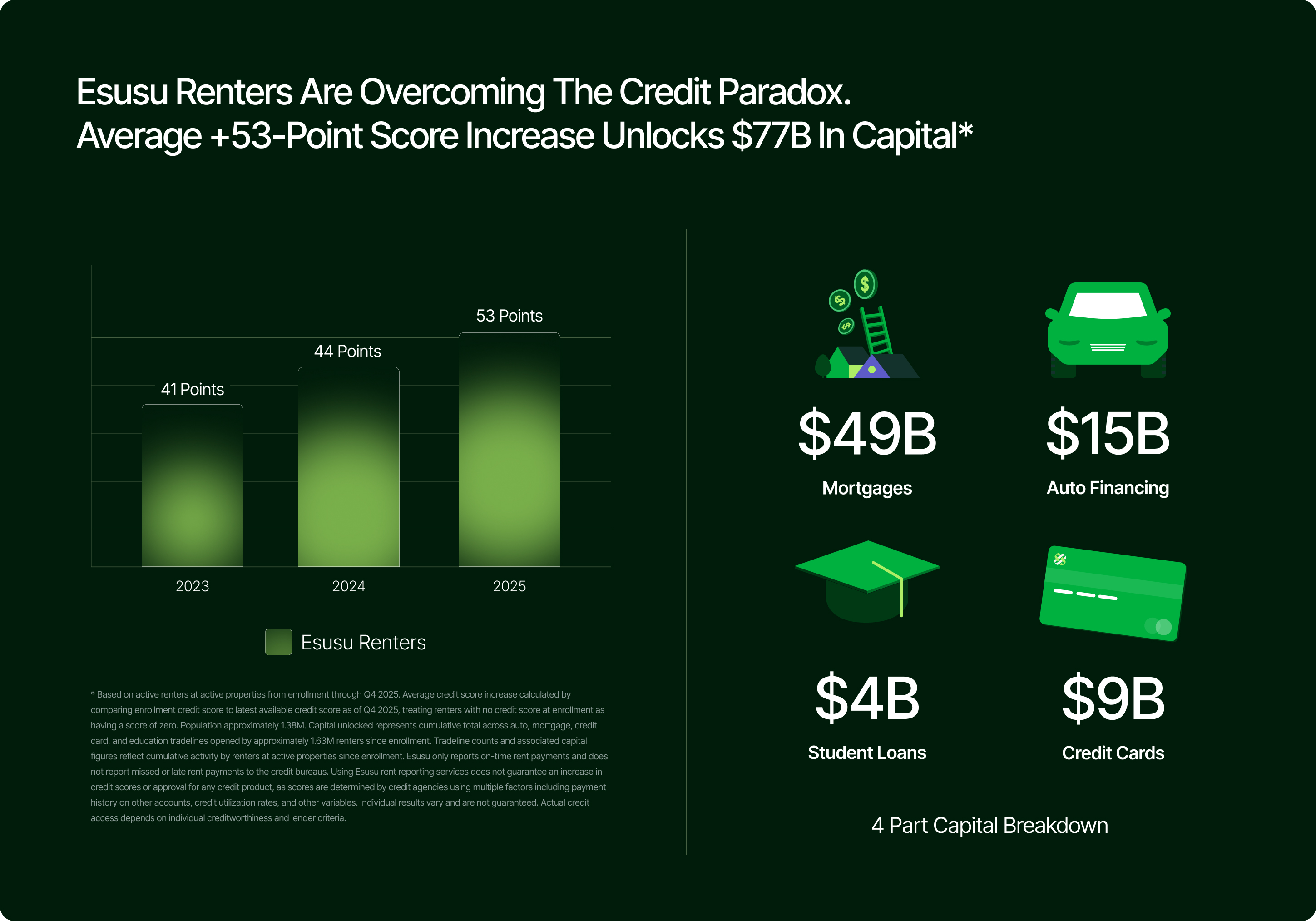
- The 53-Point Jump: Renters using positive rent reporting saw an average boost of 53 points within just six months.
- Zero to 600: For the 272,000 credit invisible Americans we’ve helped, rent reporting didn’t just move the needle—it created the needle, establishing scores of 600+ almost instantly.
Why This Matters for Credit Building and Building Wealth
As an Esusu renter, we know you are not only building your credit score. You are managing cash flow and looking for a path to financial security. Rent payment history is becoming normalized in underwriting and by reporting yours, you are essentially practicing for your future home or auto loan in the eyes of the bank.
Take it from Esusu renters who have used this momentum to unlock $77 billion in capital, including $49 billion in mortgages. Rent reporting helps renters participate in the mainstream financial system by building a credit file, which is essential for financial stability and access to financial products.
How It Works with Credit Bureaus (Without the Headache)
You have enough on your plate. We made sure this process requires zero extra work from you:
- Seamless Integration: There are no “hard inquiries” (the kind that dings your score). We simply link to your existing payment system. Monthly rent payments are automatically reported to the credit bureaus, establishing a rental tradeline or account on your credit report. For a practical breakdown of how renters can get started, compare options, and avoid common mistakes, read How to Turn Rent Payments Into Credit: A Guide For Renters.
- .Positive-Only Reporting: Life happens. Esusu focuses on your wins. We report your on-time payments to highlight your reliability, helping you build a positive payment history. Some services offer positive-only reporting (only reporting on-time payments), while others provide full-file reporting (including late payments); positive-only reporting emphasizes your strengths without penalizing you for occasional setbacks.
- Automatic Credit-Building: You pay rent, we tell the bureaus. You get the “receipts” for your biggest expense in the form of a higher score. This reporting work transforms your rent payments into a credit-building tool, just like making payments on a loan or credit card.
Some rent reporting services charge a monthly fee or a one-time setup fee, while others offer free rent reporting for tenants. Always check for hidden cost to ensure transparency and affordability.
Stop Paying "Silent" Rent: Make Your Rent Payments Count
In 2026, paying rent without reporting it is like working a job and refusing a paycheck. You’re doing the work—you deserve the credit. Don’t let your biggest monthly expense stay silent.
Check with your property manager to see if your building offers Esusu Rent Reporting. If a rent reporting service isn't available through your landlord or property manager, you can sign up for rent reporting directly. Start today by downloading the Esusu app and signing up for Esusu Membership for $59/year.


.png)

