
.svg)


.png)
In 2026, the United States marks 250 years since the Declaration of Independence. One way to understand these 250 years is as a story of unfinished promises. Every generation has had to grapple with the gap between the country’s soaring language and its lived reality. African American communities, in particular, have treated the founding documents less as sacred relics and more as contracts to be enforced: organizing, litigating, voting, and creating in order to pull the law and the economy closer to their stated ideals.
It is also a story about expanding the “we” in “We the People.” In 1776, that “we” did not include enslaved Africans, most women, Indigenous nations, or many poor people. Over time, through abolition, Reconstruction, the Civil Rights Movement, the Women’s Rights Movement, the Voting Rights Movement, and today’s multiracial coalitions, Black struggle has been the engine that widens the circle of belonging.
At 250 years, America is not a finished product; it is a democracy under constant renovation. For a company like Esusu—founded to help dismantle barriers to housing and bridge the racial wealth gap—this anniversary serves as a progress report on how we are moving from a nation that Black labor helped build but was locked out of owning, to a nation where Black families can build wealth, vote without obstruction, and live with dignity.
Remembering how this story began is essential to imagining where it can go next.
The Arrival in 1619
Long before the first Fourth of July, there was August 1619.
That month, an English privateer ship called the White Lion dropped anchor off Point Comfort in the Virginia colony, near what is now Fort Monroe. Onboard were “20 and odd Negroes,” as one English official recorded them: African men and women violently taken from the continent and forced onto a Portuguese slave ship, then seized again by English raiders on the Atlantic crossing. Their names, languages, and family ties were mostly erased from English records, but their labor and knowledge would become part of the foundation on which early American wealth was built.
It is important to say that 1619 is not the beginning of Africans in the Americas. Africans had lived and labored in Spanish Florida and other colonies for generations. But 1619 is a powerful origin point for African American life in what became the United States. To remember that landing is to confront both the brutality of the Atlantic slave trade and the enduring humanity of the people who survived it and transformed an unimaginably hostile world into a place where new cultures, families, and communities could take root.
Trials, Tribulations, and Resilience
From 1619 onward, Black life in America has been marked by deep injustice and equally deep resilience. To tell only the story of harm is to flatten African American communities into victims. The fuller story is one of agency, creativity, and perseverance in the face of systems designed to break them. Across the centuries, a pattern emerges:
- As Reconstruction gave way to Jim Crow, segregation laws stripped African Americans of voting rights, land, and equal access to public life. In response, communities built independent institutions: Black churches, historically Black colleges and universities (HBCUs), newspapers, fraternal lodges, and businesses. Poets, musicians, and visual artists turned trauma into blues, jazz, sermons, and literature that named injustice while asserting pride, beauty, and complexity.
- In the World Wars and Cold War era, Black service members fought abroad for “freedom” while facing discrimination at home and inside the military. They responded with “Double V” campaigns—victory over fascism abroad and racism at home—using their uniforms and sacrifices to demand civil rights and desegregation.
- In the late 20th century, as factories closed and the War on Drugs accelerated mass incarceration, many Black neighborhoods were hollowed out by unemployment and over-policing. Families and organizers responded by building reentry programs, legal defense funds, youth mentoring organizations, and powerful cultural commentary in hip-hop, spoken word, and film.
Across these eras, the forms of oppression change but so do the forms of resistance. The through-line is a refusal to accept dehumanization as the final word, and a consistent commitment to building something better for the next generation, even when the odds are long.
Movements That Shaped the Nation
The Civil War and the Fight Over Slavery: The Civil War is often described as a battle to “preserve the Union,” but at its core it was a fight over the future of slavery. Enslaved people themselves helped turn it into a war of liberation by fleeing plantations, sabotaging Confederate production, and seeking refuge behind Union lines. Their actions forced federal officials to treat them not as property, but as people whose freedom was a military and moral necessity.
By war’s end, nearly four million enslaved people were legally freed, and slavery was abolished in most forms through the 13th Amendment. Black soldiers and sailors—about 180,000 served in the Union army and tens of thousands more in support roles—proved indispensable to victory. In destroying slavery, the country redefined what “freedom” could mean for poor white farmers, immigrant laborers, and others trapped in exploitative systems built on slavery’s logic.
The Emancipation Proclamation: Issued on January 1, 1863, the Emancipation Proclamation declared enslaved people in Confederate-held territories “forever free.” It did not instantly free everyone. Border states and some occupied areas were exempt, but it changed the purpose of the war and opened the door to Black enlistment in the Union forces.
The Proclamation signaled that the federal government was willing to use its power on the side of liberation. It became a touchstone for future movements, proof that the state could be compelled to intervene against entrenched injustice. The idea that federal authority can and should protect civil rights—in schools, workplaces, and housing—traces back in part to this moment.
The Women’s Rights Movement: The early public story of the Women’s Rights Movement often centers white suffrage leaders and milestones like the 1848 Seneca Falls Convention and the 19th Amendment in 1920. But Black women were at the forefront and at the margins: leading, organizing, and theorizing even as they were excluded from many white-led organizations.
Sojourner Truth’s famous 1851 “Ain’t I a Woman?” speech challenged both racism and sexism. Ida B. Wells exposed lynching and fought for suffrage while confronting segregation within the suffrage movement itself. Organizations like the National Association of Colored Women linked voting rights to education, labor protections, and anti-violence work. Their intersectional vision—insisting that racism, sexism, and economic injustice must be tackled together—helped shape modern feminism and broaden the agenda for gender equity, LGBTQ+ rights, and disability justice.
The Civil Rights Movement: The mid-20th-century Civil Rights Movement was a mass movement for Black freedom against segregation, white supremacy, and second-class citizenship. It was powered not only by well-known figures like Martin Luther King Jr. and Rosa Parks, but by local leaders, Black women organizers, young people, and everyday church members.
Through boycotts, sit-ins, Freedom Rides, court cases, and mass marches, the movement won landmark victories: Brown v. Board of Education (1954), the Civil Rights Act (1964), and the Fair Housing Act (1968), among others. These laws did more than help Black communities; they created a legal toolkit that has since been used by women, religious minorities, LGBTQ+ people, people with disabilities, and others to challenge discrimination. The strategies honed in Black churches and meeting halls became a blueprint for rights-based advocacy across society.
The Voting Rights Movement: If democracy is the system that translates people’s voices into power, then voting is its most basic tool. After the Civil War, the 15th Amendment promised that race would not bar men from voting. In practice, poll taxes, literacy tests, grandfather clauses, violence, and gerrymandering nearly erased Black political power in large parts of the country for generations.
The Voting Rights Movement, from Reconstruction through Freedom Summer and the Selma-to-Montgomery marches, fought to change that. The Voting Rights Act of 1965 finally banned many of the worst practices and placed jurisdictions with a history of discrimination under federal oversight. Within a few years, Black voter registration and representation surged across the South.
These protections later expanded to include language minorities and people with disabilities. And when new forms of voter suppression emerged (strict ID laws, polling-place closures, purges of voter rolls) Black-led organizations once again built the infrastructure to defend democracy for everyone.
Innovation and Contributions: A Historical Timeline
Black history is not only a record of protest; it is also a record of innovation. Black inventors, entrepreneurs, scientists, artists, and public servants have continuously reshaped American industry, culture, and governance, often while shut out of the very institutions they transformed.
1600s–1700s: Foundations
- 1731–1806 – Benjamin Banneker (Science & Mathematics)
A largely self-taught astronomer and surveyor, Banneker produced respected almanacs and helped survey the boundaries of Washington, D.C., demonstrating Black scientific excellence in a young country.
1800–1865: Innovation Under Slavery and War
- 1821 – Thomas L. Jennings (Technology & Business)
Jennings, a New York tailor, received a patent for a dry-cleaning process—one of the first U.S. patents granted to a Black inventor. He used his earnings to support abolitionist causes, turning technical innovation into fuel for social change.
1865–1900: Reconstruction and Industrialization
- 1884 – Lewis Howard Latimer (Electrical Engineering)
Latimer improved the carbon filament used in light bulbs and authored a key text on electric lighting, making electric illumination more practical and advancing the electrification of U.S. cities. - 1887 – Granville T. Woods (Transportation & Communications)
Woods patented dozens of devices for railroads, including improved telegraph systems and braking technologies, helping to make train travel safer and more efficient. - 1892 – Sarah Boone (Domestic Technology & Design)
Boone, a dressmaker, patented a curved ironing board better suited to women’s garments, modernizing a ubiquitous tool of domestic and commercial labor.
1900–1945: Business, Data, and Culture
- Early 1900s – Madam C. J. Walker (Beauty Industry & Entrepreneurship)
Walker built a national hair-care empire serving Black women, trained thousands of sales agents, and became one of America’s first self-made women millionaires. She invested heavily in education and civil rights. - 1940s – Dr. Charles R. Drew (Medicine & Blood Banking)
Drew developed improved methods for processing and storing blood plasma, directing large-scale blood bank programs during World War II and helping institutionalize modern blood banking.
1945–1970: Space, and Political Firsts
- 1960s – Katherine Johnson, Dorothy Vaughan & Mary Jackson (Mathematics & Aerospace)
Their calculations and programming at NASA were crucial to human spaceflight and orbital missions, even as they fought segregation and sexism inside federal laboratories. - 1968–1972 – Shirley Chisholm (Electoral Politics)
The first Black woman elected to Congress and the first to seek a major party’s presidential nomination, Chisholm expanded who could imagine themselves in national leadership.
2000–Present: Digital Organizing, Inclusive Tech, and New Frontiers
- 2008–2016 – Barack Obama and his campaigns (Politics & Digital Strategy)
Obama’s campaigns fused grassroots organizing, data analytics, and online fundraising at scale, changing modern electoral strategy and opening new horizons for Black political leadership. - 2011–Present – Kimberly Bryant & Black Girls CODE (Education & Tech Pipeline)
Black Girls CODE has helped shift how the tech industry and philanthropy think about who belongs in STEM, building a pipeline of Black girls entering coding and engineering. - 2020 – Dr. Kizzmekia Corbett (Immunology & Public Health)
A key scientist behind one of the first mRNA COVID-19 vaccines, Corbett exemplifies Black leadership at the cutting edge of biomedical research and public health.
This list is only a glimpse. But it makes one thing clear: Black innovation is not a side story to American progress—it is one of its main engines.
Lesser-Known Contributions
Beyond marquee names and national movements lies a rich ecosystem of everyday leadership—neighborhood givers, soldiers, small business owners, and local officeholders—whose stories rarely make textbooks but profoundly shape American life.
Generosity and Philanthropy
Black generosity has long outpaced Black wealth. Studies consistently show that Black households give a larger share of their income to charity often through churches, mutual aid, and direct support to family and neighbors, even as the typical Black family holds far less wealth.
From the 18th and 19th centuries onward, mutual aid societies like the Free African Society pooled small dues to provide burial insurance, support widows and orphans, and pay for schooling when public systems excluded Black people. Black churches functioned as de facto community foundations, using tithes to fund everything from the Underground Railroad to scholarship funds and civil rights campaigns.
In the 20th century, a washerwoman named Oseola McCarty quietly saved her modest earnings and then donated most of her life savings—$150,000—to fund scholarships at the University of Southern Mississippi. Today, Black-led giving circles and funds continue this tradition, channeling small individual gifts into sizable grants for Black-led organizations and grassroots movements.
Military Service
African Americans have served in every major U.S. conflict, often fighting for freedoms they were denied at home.
Crispus Attucks, of African and Native descent, is remembered as one of the first to die in the Boston Massacre. During the Revolutionary War, Black soldiers fought in integrated and segregated units, sometimes promised freedom for their service. In the Civil War, units like the 54th Massachusetts and the broader United States Colored Troops fought in some of the hardest battles, helping to secure the Union victory that ended slavery in law.
In the World Wars, Black units such as the Harlem Hellfighters, the Montford Point Marines, and the all-Black Six Triple Eight women’s battalion distinguished themselves despite segregation and discrimination. Their service helped lay the groundwork for President Truman’s 1948 order desegregating the armed forces and has continued to influence debates about service, citizenship, and opportunity.
Today, Black Americans make up a higher share of active-duty personnel than of the overall population—evidence both of patriotism and of the reality that the military has sometimes offered clearer pathways to education, training, and homeownership than the civilian labor market.
Entrepreneurship
Despite enduring barriers to capital, networks, and contracts, Black entrepreneurs have built robust business ecosystems.
Early-20th-century “Black Wall Streets,” such as Greenwood in Tulsa, Oklahoma, showcased dense clusters of Black-owned banks, law offices, shops, and entertainment venues. Many of these districts were destroyed in racist violence or undermined by discriminatory policies like redlining and highway construction, but they remain powerful examples of what Black enterprise can create.
Black women in particular have long led in entrepreneurship—from Madam C. J. Walker and other Jim Crow–era magnates who built national companies, to the countless hairstylists, caterers, child-care providers, and online sellers who sustain local economies today. Recent data show that Black women are now one of the fastest-growing groups of entrepreneurs in the country, even though they continue to face outsized barriers to funding and scale.
Local examples, such as the high share of Black-owned small businesses in cities like Washington, DC, illustrate how targeted support—certification programs, technical assistance, procurement goals—can unlock both jobs and generational wealth.
Esusu’s Work: Carrying the Legacy Forward
The arc from 1619 to 2026 is long, braided, and unfinished. It runs from people bought and sold on a Virginia shore, through generations who built this country’s wealth without being allowed to share in it, to today’s innovators who are redesigning systems so that Black and brown families can finally build the stability and opportunity they were promised.
Esusu was founded squarely in this tradition of resilience and innovation in the face of exclusion.
For centuries, Black labor has fueled American prosperity while Black families were systematically denied fair access to credit, homeownership, and capital. Traditional credit systems often fail to recognize the full financial lives of renters and immigrants, treating them as “thin-file” or “high-risk” even when they pay their largest bill—rent—on time, month after month. That is one of the ways the racial wealth gap is reproduced in real time.
Esusu’s mission is simple and ambitious: dismantle barriers to housing for working families and unleash the power of data to bridge the racial wealth gap. We do that by making on-time rent count toward credit building, pairing rent relief with rent reporting, and equipping property owners and residents with tools that turn housing from a vulnerability into a platform for mobility.
The impact is measurable (Read our 2025 Year in Review blog):
- Unlocking credit at scale: As of December 2025, renters participating in Esusu’s platform have unlocked nearly $77 billion in new credit tradelines, including more than $49 billion in mortgages, over $15 billion in auto loans and over $4 billion in student loans. These are dollars that help families buy homes, secure reliable transportation, manage emergencies, and invest in education.
- Strengthening housing stability: Through our rent relief work, Esusu and our partners have disbursed about $26 million in funds, helping more than 13,000 families avoid eviction. In a housing market defined by rising rents and widening inequality, keeping families in their homes is a direct intervention in the cycle that turns a short-term setback into long-term financial ruin.
- Opening the door to credit for the first time: Roughly 250,000 renters have established a credit score for the very first time through Esusu’s rent reporting. For many, this is the difference between being invisible to the financial system and having the standing to secure a safe apartment, a small business loan, or a lower-interest car note.
- Improving credit health over time: Historically, renters on our platform saw an average credit score increase of about 53 points across a cohort of roughly 5 million residents through December 2025. For someone on the margin between subprime and prime credit tiers, that kind of movement can translate into thousands of dollars saved in interest and fees over a lifetime
- Moving from subprime to prime: By late 2025, about 12% of renters in our portfolio had moved from subprime to prime credit tiers while using Esusu. That shift is not only about numbers on a report; it is about access—to lower-cost credit, better financial products, and more dignified financial options.
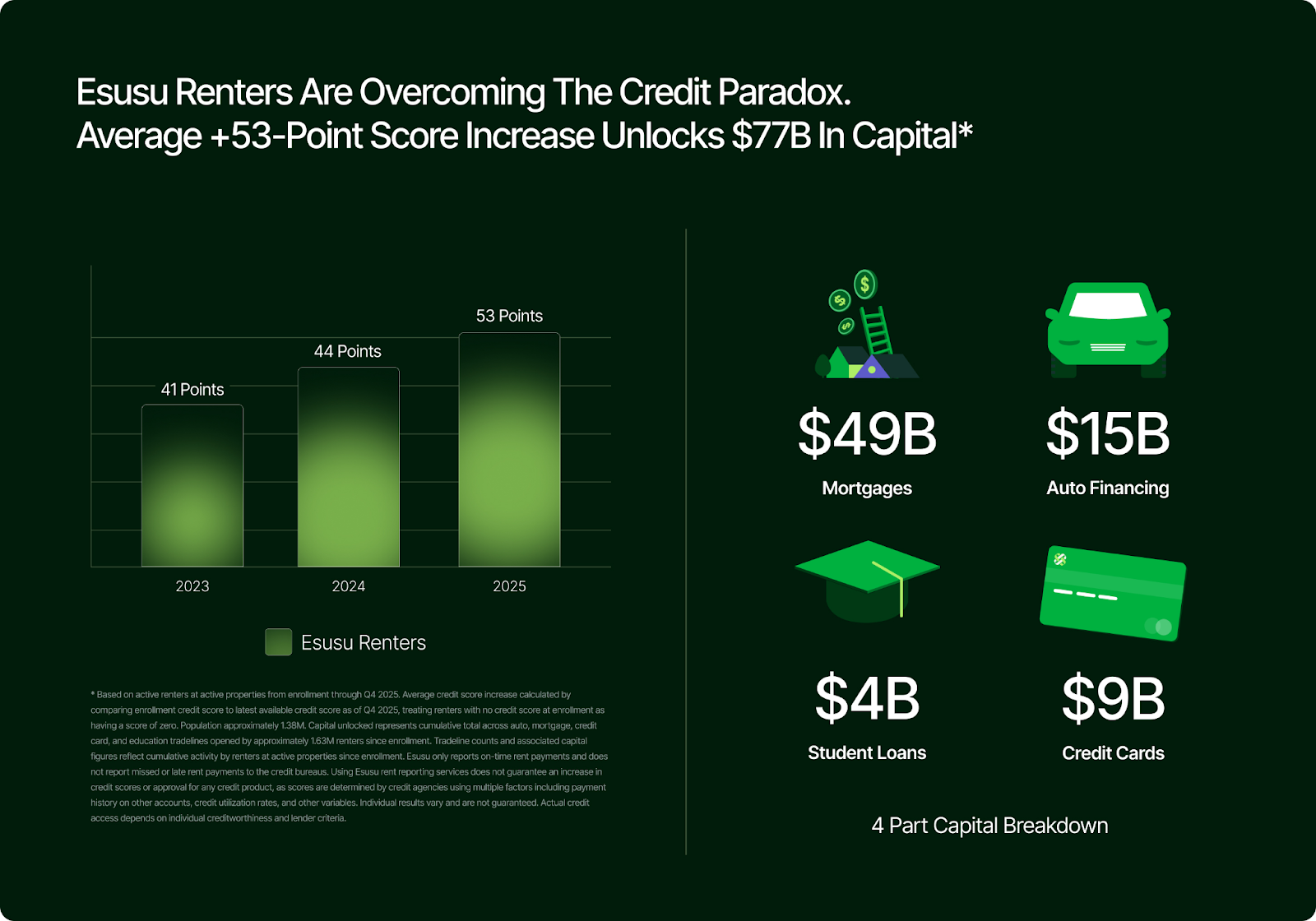
These outcomes do not erase centuries of exclusion, but they demonstrate what is possible when we recognize renters as valuable financial citizens and redesign systems around that truth. They are one piece of a much larger ecosystem of Black-led and equity-focused work—in policy, philanthropy, entrepreneurship, and community organizing—aimed at finally aligning the country’s financial architecture with its democratic ideals.
As America approaches its 250th year, the question is not whether Black people have contributed enough to earn full inclusion. The question is whether our institutions, including the financial and housing systems, are finally willing to be remade in line with the contributions, creativity, and humanity that have always been there.
The next 250 years of American history are being written now, in decisions about who has access to stable housing, fair credit, and the chance to build wealth. Our commitment is to ensure that Black communities, and all communities historically left on the margins, are not only present in that story—but centered in its progress.