






.png)
Searching for a new apartment can be exciting. You look through listings, visit properties, and imagine where your furniture will go.
Then comes the part that can feel less exciting: submitting an application and waiting for a landlord to review your information.
Many renters know that landlords may check their credit. Fewer renters know that a landlord may also review a separate document called a rental history report or tenant screening report.
This report may include information about where you have lived, whether you paid rent on time, past eviction cases, unpaid rental balances, and other details connected to your housing history.
If the report contains incorrect information, it could make it harder to rent your next home.
The good news is that you do not have to wait until your application is denied to learn what may be in your file. Checking your rental history report before you apply gives you time to find errors, collect supporting documents, and understand your rights.
This guide explains what a rental history report is, how to request one, how to get a free copy in certain situations, and how to dispute information that is wrong or incomplete.
Key Takeaways
- A rental history report is different from a standard credit report. It focuses on your housing and rental history.
- Different landlords may use different tenant screening companies, so there may not be one report that includes everything about you
- You can request a copy of the report created by a tenant screening company.
- If a landlord takes negative action because of a screening report, you may be able to request a free copy within 60 days.
- You should review the report for incorrect addresses, outdated records, mixed files, and paid debts listed as unpaid.
- You can dispute information that is inaccurate or incomplete.
- Traditional rent payments do not appear on credit reports automatically. A rent reporting service may help eligible renters add on-time payments to their credit history.
What Is a Rental History Report?
A rental history report is a type of tenant screening report. Landlords and property managers may use it when deciding whether to rent to an applicant and what rental terms to offer.
The report may include information collected from property management systems, public court records, consumer reporting companies, and debt collection agencies.
Reports can be different from one company to another. Not every company will have information about every renter.
A rental history report may include:
- Previous rental addresses
- Lease start and end dates
- Rental payment information
- Eviction filings or judgments
- Unpaid rent or move-out balances
- Property damage claims sent to collections
- Records of returned checks or electronic payments
- A risk score or recommendation created for a landlord
Not every report will include all of these items. The information depends on the company that created the report, the data available to that company, and the information requested by the landlord.
The Consumer Financial Protection Bureau explains what a tenant screening report may contain and how it differs from a standard credit report.
Rental History Report vs. Credit Report
A credit report focuses on your borrowing and repayment history. It may include credit cards, personal loans, student loans, auto loans, mortgages, and other credit accounts.
A rental history report focuses on your experience as a renter. It may show where you lived, whether you paid rent, and whether a landlord reported an eviction or unpaid balance.
These reports are connected, but they are not the same.
You could have a strong credit report and still find incorrect information on a rental history report. You could also have a limited credit history but a positive record of paying rent on time.
It is also important to understand the difference between a rental history report and rent reporting.
A rental history report is used to review your past as a renter. Rent reporting is the process of sending eligible rent payments to credit bureaus so they can be added to your credit history.
What Do Landlords Look For?
Landlords and property managers usually want to understand whether an applicant is likely to pay rent on time and follow the terms of a lease. They may review several parts of a tenant screening report, including:
Payment history
A history of on-time rent payments can show that you paid your housing costs consistently. However, not every landlord receives or reviews the same payment information.
Eviction records
A report may include an eviction filing, judgment, or other court record. The outcome matters. A dismissed or resolved case should not be presented as an active eviction judgment.
Unpaid balances
A landlord may review whether a previous rental balance was sent to a collection agency. If you paid a balance, keep proof of payment and check that the report shows the correct status.
Lease compliance
Some landlords may look for records connected to breaking a lease, property damage, or other lease disputes. The details and reporting rules can vary, so the report should be reviewed carefully rather than assumed to be complete or accurate.
Returned payments
A report may include bounced checks or returned electronic rent payments. If a payment was returned because of a bank error and later resolved, keep documentation that explains what happened.
A rental history report is only one part of an application. Landlords may also consider income, employment, references, credit information, and their own application criteria.

How Can I Check My Rental History Report?
There is no single report used by every landlord. Different property managers may use different tenant screening companies. The steps below can help you find the reports that may be connected to your rental history.
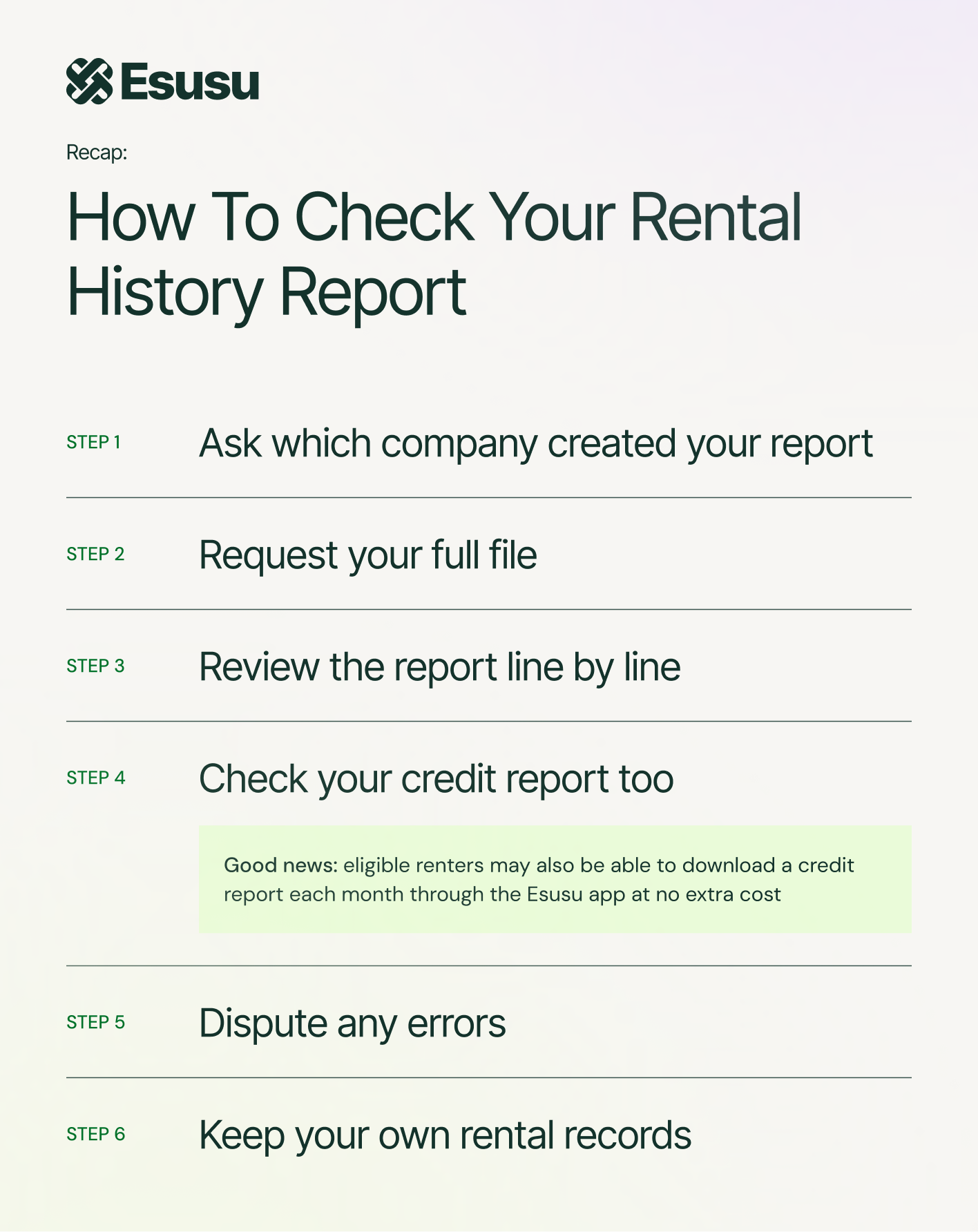
Step 1: Ask which company created your report
If you have already applied for an apartment, ask the landlord or property manager which company created the screening report.
If your application was denied or your rental terms changed because of information in the report, the landlord should provide the company’s name and contact information in an adverse action notice.
An adverse action can include being denied an apartment, being asked to pay a higher security deposit, or being required to provide a co-signer because of information in a consumer report.
If you have not applied yet, you can review the CFPB’s list of consumer reporting companies. Look for companies that provide tenant screening, rental history, eviction, or related consumer reports.
The list is a starting point, not a guarantee that every company has information about you. You may need to contact more than one company to understand what information could be used in an application.
Step 2: Request your full file
Visit the reporting company’s official website and look for a page called “Consumer Disclosure,” “Request Your Report,” or “Request Your File.” Request your full file disclosure, not only a score or summary.
A full file may provide more detail about the information used to create a report. It can help you see the addresses, payment records, court information, and other data connected to your file.
You may need to provide information to confirm your identity, such as:
- Your legal name and any previous names
- Your date of birth
- Your current address
- Previous addresses
- Your Social Security number or Individual Taxpayer Identification Number, when required
Only submit sensitive information through the company’s secure website or official contact method. Do not send your Social Security number through regular email or to an unverified contact.
Some companies may ask for additional documents, such as a copy of an identification document or proof of address. Follow the company’s instructions and keep a copy of what you submit.
Step 3: Review the report line by line
When you receive the report, read every section carefully. Do not only look for an eviction. Small errors, such as an incorrect address or balance, can also create confusion during an application.
Check that:
- The addresses match places where you actually lived
- Lease start and end dates are correct
- Your name and identifying information are correct
- Payment information is accurate
- Eviction cases show the correct outcome
- Dismissed, sealed, or resolved cases are described correctly
- Paid balances are not listed as unpaid
- Information from another person has not been added to your file
- Collection accounts belong to you and show the correct balance
Tenant screening reports can contain outdated or inaccurate information.
The CFPB has reported that these errors can make it harder for renters to find housing. Finding a problem before you apply gives you more time to respond.
If you do not understand an entry, write down the name of the company that reported it, the date of the entry, and the contact information listed on the report. This will make the next step easier.
Step 4: Check your credit report too
A rental history report and a credit report are different documents. A rental history report focuses on your housing history, while a credit report focuses on credit accounts and payment activity.
It can be helpful to review both before you apply for an apartment. Look for accounts that do not belong to you, incorrect balances, duplicate information, or payments reported incorrectly.
Eligible renters may also be able to download a credit report each month through the Esusu app at no extra cost. The app may also show your credit score, score history, and rent reporting activity.
A credit report from the Esusu app does not replace the rental history or tenant screening report used by a landlord. If you are applying for an apartment, review the specific report used in the rental decision whenever you can.
Step 5: Dispute any errors
If you find information that is wrong, incomplete, or outdated, collect documents that support your claim. Useful documents may include:
- Lease agreements
- Bank statements
- Rent receipts
- Payment confirmations
- Letters from a previous landlord
- Move-out statements
- Documents showing that a balance was paid
- Court documents showing that a case was dismissed, sealed, or resolved
Send a written dispute to the company that created the report. Explain what is wrong, identify the specific item you are disputing, include copies of your supporting documents, and keep a record of when you sent the dispute.
Many companies allow online disputes. An online submission may be faster, but a letter sent through certified mail can also create a clear record of your request.
Do not send original documents unless the company specifically asks for them.
The company generally has 30 days to investigate a dispute. If you provide additional information during the investigation, the period may be extended to 45 days. Read the CFPB’s guide on what to do if your rental application is denied because of a tenant screening report for more information.
If the company does not correct an error after you provide proof, you may want to seek help from a consumer protection agency or a qualified legal professional. State rules may provide additional rights.
Step 6: Keep your own rental records
Create a digital or paper folder with documents from each home you rent. Keep copies of:
- Signed leases
- Rent receipts or bank records
- Written communication with your landlord
- Move-in and move-out documents
- Security deposit records
- Payment plans or settlement agreements
- Confirmation that a balance was paid or resolved
These records can help you explain your rental history and support a dispute if the report is missing information or contains an error.
They can also help you complete future rental applications more accurately.
How the Esusu Passport Helps You Share Your Rental History
Keeping your own rental records can make it easier to show your payment history when you apply for a new home. If you’re eligible for Esusu Passport, you may have an easier way to keep that information together and share it when you need it.
Available through the Esusu app, Esusu Passport gives eligible renters a verified, shareable record of their rental payment history at no extra cost. Instead of pulling together bank statements, rent receipts, or landlord references, you can use your Passport to share available payment history and current lease details with a prospective landlord or property manager.
For eligible renters, Esusu Passport begins to populate after at least 90 days of consecutive rent reporting, based on rental payment information available to Esusu. You choose when and with whom to share your information.
Esusu Passport is not a consumer report and does not replace a landlord’s tenant screening process. Instead, it can serve as supporting documentation that provides additional context about your rental payment history. Eligibility and program details may vary.
How to Get Your Rental History Report for Free
There are several situations in which you may be able to receive a rental history or tenant screening report at no cost. The rules depend on the reporting company and the reason you are requesting the report.
After an adverse action
The fastest way to get a free report may be after a landlord takes adverse action against you. This can include denying your application, requiring a higher security deposit, or asking for a co-signer because of information in a tenant screening report.
In that situation, the landlord should give you an adverse action notice. The notice should identify the company that created the report and explain your right to request a free copy within 60 days.
Contact the reporting company listed in the notice as soon as possible. Tell the company that you are requesting the free report connected to the adverse action and keep a copy of your request.
Annual file disclosures
Some consumer reporting companies also provide a free file disclosure every 12 months. The rules and eligibility requirements can vary by company.
Check the company’s official instructions and the CFPB’s current list before submitting your request.
A request for your own consumer report is different from a hard credit inquiry.
Requesting your own report generally does not lower your credit score, but always follow the reporting company’s instructions.
What If You Lived With Your Parents?
If you are applying for your first apartment and have been living with family, do not leave the rental history section blank.
You can list your parents’ address, explain that you resided with family, and include the dates you lived there. You can also provide information that helps show you are prepared to rent, such as:
- Proof of income or employment
- Proof of savings
- A personal reference
- A co-signer, if required
- A letter explaining your housing history
Answer the application truthfully.
Living with family does not automatically mean you have a negative rental history. It simply means you may need to provide other information to show that you can meet the lease requirements.
How Far Back Does a Rental History Check Go?
The answer depends on the landlord, the screening company, the type of information being reviewed, and state law. Some reports may review several years of rental history. Court records, collection accounts, and other information may follow different reporting rules.
Do not assume that an old record is automatically accurate or still reportable. Review the dates and the outcome of each entry. If information is outdated or incorrect, you can ask the reporting company to investigate it.
How Long Does an Eviction Stay on Your Record?
An eviction filing and an eviction judgment are not always the same thing.
A case may be dismissed, settled, sealed, or resolved in another way. The report should show the correct status when that information is available.
In many situations, an eviction judgment may appear for up to seven years, but the rules can vary by state and by the type of record.
If you paid a related debt or the case was dismissed, keep documents that show the outcome and dispute information that is incomplete or misleading.
How Esusu Can Help You Build Credit With Rent
Checking your rental history report helps you understand your past. Rent reporting can help make eligible on-time rent payments part of your credit history going forward.
Traditional rent payments do not appear on credit reports automatically. A rent reporting service sends payment information to credit bureaus so it can be considered by the credit scoring models and lenders that use that data.
With Esusu rent reporting, eligible on-time rent payments may be reported to Equifax, Experian, and TransUnion. Esusu only reports on-time rent payments through its service.
Esusu may also be able to report up to 24 months of past on-time rent payments when reliable records are available. Eligibility and program details may vary.
Rent reporting does not guarantee a credit score increase or approval for a credit product. Credit scores are based on multiple factors, and different lenders and scoring models may use rental data in different ways.
For more detail, read how Esusu rent reporting affects your credit.
Frequently Asked Questions About Rental History Report
Ready to Make Your Rent Count?
You are already paying rent. The next step is to see whether those payments can help build your credit history.
Download the Esusu app to check whether your rental community offers rent reporting at no cost or to review available enrollment options.
You can also learn more about Esusu Rent Reporting and how eligible on-time payments may support your credit-building journey.
Results vary, but rent can be one more tool you use as you work toward your financial goals.


.png)

